It was during one of the scores of interviews I did for ‘The Man Who Bled Blue’ that the question came back at me: Why? Why write a book about Mike Lyons?
The person posing the question had experienced the 1970s up close at Goodison Park and was sceptical about the appetite for a journey back to an era of gnawing frustrations and heart-rending near-misses for Evertonians.
What is more, Lyons – Mick to the fans, Michael to his family, Mike as the compromise – embodied those frustrations like no other player as the club’s long-serving captain.
On the day he made his debut in March 1971, Everton were the reigning champions and four days away from contesting a European Cup quarter-final. On the day he left Everton in June 1982, they had not held another trophy since. To make matters worse, he had won just one of the 21 derbies he played in – against a Liverpool side who spent the 70s amassing silverware as Lyons collected heartbreaks.
Lyons did not need telling any of this. As a boyhood Blue and Goodison’s original Croxteth Kid – three decades before Wayne Rooney received that moniker – he experienced the disappointments deeply, from controversial and shattering FA Cup semi-final defeats to an agonising League Cup final loss via head-scratching stumbles in pursuit of the league title.
Indeed, when I once asked him, a couple of decades ago, about collaborating on a book, the gist of his reply was: who’d want to read about me? “A jinx” is how he would self-deprecatingly describe himself.
Yet there are such strong reasons why his story warrants telling, why it pays to relive that era – as colourful as it was occasionally calamitous – with the man who lived it more intensely than any other.
It is no exaggeration to say that across his 473 appearances, no Everton player ever gave more of himself. A photo of his diving header against then-champions Leeds United in 1974 – Lyons flying low to reach the ball just ahead of the boot of fearsome centre-back Norman Hunter – adorned the walls of the club’s old training ground at Bellefield for years to follow. It was a lesson to young players arriving at the club about the level of commitment demanded.
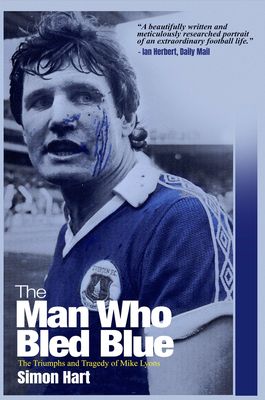
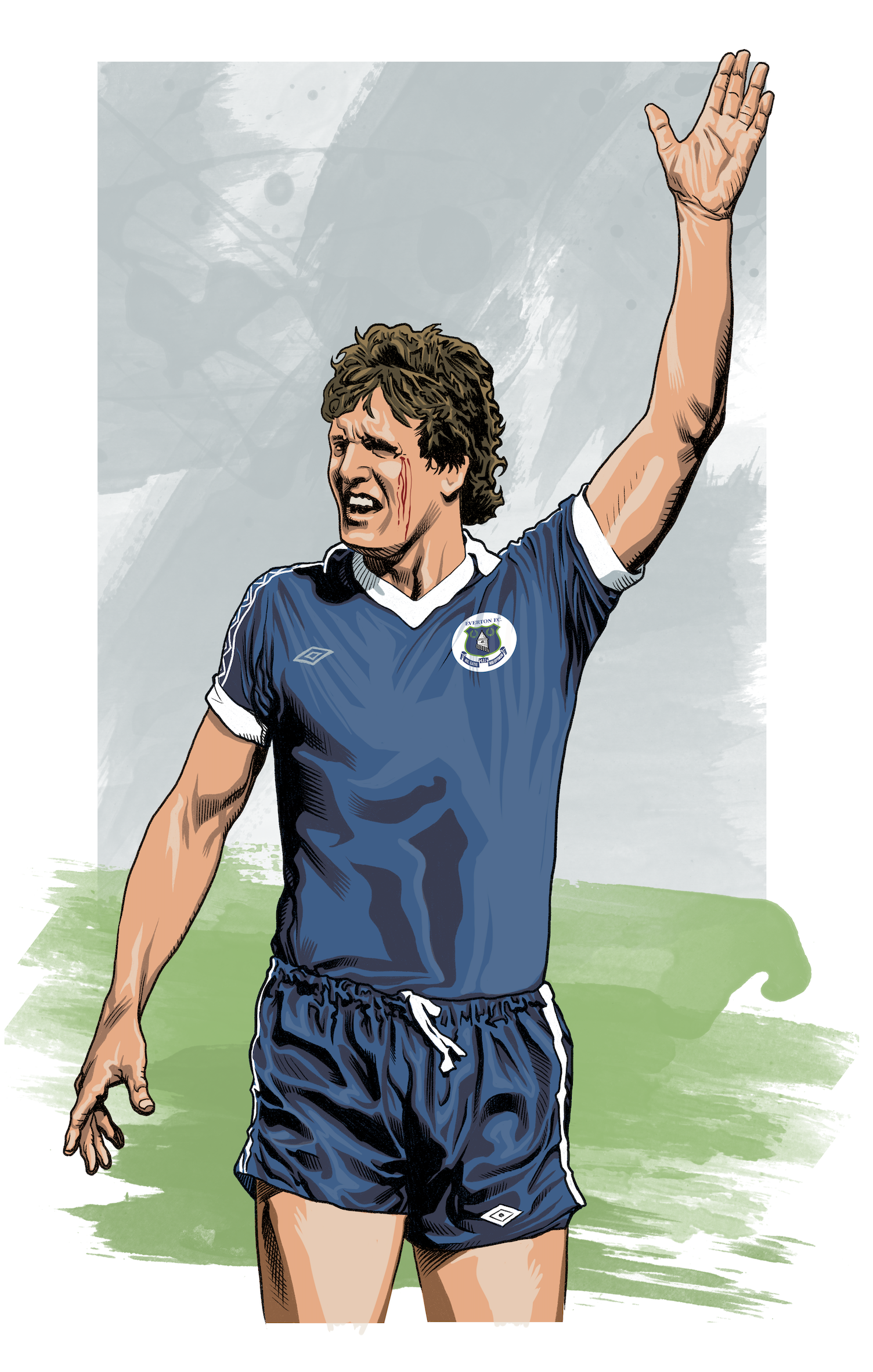
Nowadays another photo of Lyons, his face bloodied at the end of the 1980 FA Cup semi-final against West Ham, sits on a wall at Finch Farm, Everton’s training ground today. A different image (seen on the cover of ‘The Man Who Bled Blue’), yet the message is the same. “He’d run through a brick wall and head everything that moved,” the great Colin Harvey underlined to me – and that was both as centre-back and in the emergency centre-forward role he so often filled (and which helped yield his total of 59 goals for the club).
Tragically, the courage he displayed in both roles would eventually carry a terrible cost, as this book explains when documenting his diagnosis, and ongoing struggle, with dementia.
For me, there was another, deeply personal, reason to tell Mike Lyons’ story – namely, his connection with my father, Dave Hart. In his first job as a teacher, at De La Salle Grammar School in Croxteth in the 1960s, my dad took Lyons’ school team. With Lyons as captain, they won the Liverpool Echo Cup in 1966, becoming the first grammar school in the city to take that prize.
Growing up, therefore, I heard all about the young Lyons and his schoolboy feats. ‘Ask him to do a job, he’d do it,” my dad told me, uttering words that would be echoed by his future managers at Everton where he filled just about every position on the pitch, goalkeeper included.
That link to my father is what I outline in the preface to the book. One of my earliest memories of Goodison Park is of a family outing to Lyons’ testimonial match on a September night in 1980. It was later thanks to tickets from Lyons, then coaching back at Everton, that I made my first trip to Wembley for the 1989 all-Merseyside FA Cup final. His connection with my father was an enduring one – even into the last decade, he would still call his old teacher occasionally from Australia.
Therefore, when colleagues from the Everton Heritage Society suggested that a book about Lyons was long overdue, I felt compelled to take on the challenge, supported brilliantly by Mike’s daughter, Francesca, and his brother, Joe. It was a chance to learn about not just an Everton icon – the player sixth on the club’s all-time appearances list – but my dad’s one-time pupil, whose boundless love of football took him far and wide after his departure from Goodison, to Sheffield Wednesday (where, as an inspirational skipper, he helped lead the Owls back to the top flight) and Grimsby Town and on to Canada, Brunei, Singapore and Australia. And I discovered that everywhere he went, he made an impact with his enthusiasm and his sense of fun. He bled blue, for sure, but he wore a big smile too. Hence so many people gave their time so gladly to talk about him during a research process that included more than 75 interviews. Bob Latchford even insisted on a follow-up call to elaborate on the 1977 FA Cup semi-final against Liverpool, probably Lyons’ biggest heartbreak of all.
Why write a book about Mike Lyons? Fifty years since he became Everton captain, ‘The Man Who Bled Blue’ will hopefully answer that question as emphatically as a bullet header from ‘Big Mick’ himself back in the day.